The Era of the "Thin Wrapper" is Over
For the past year, the software development world has been obsessed with Large Language Models (LLMs). The initial gold rush saw thousands of applications pop up that were essentially just thin wrappers around the OpenAI API. You typed a prompt, the app sent it to the API, and printed the response. While magical at first, the limitations of this approach quickly became apparent. These systems hallucinate, they lack context about user-specific data, and most importantly, they can't actually do anything other than generate text.
As developers building the next generation of smart technology, we have to move past the simple chat interface. The real value lies in building autonomous systems, intelligent agents, and context-aware applications. To achieve this, we must master LLM Orchestration.
What is LLM Orchestration?
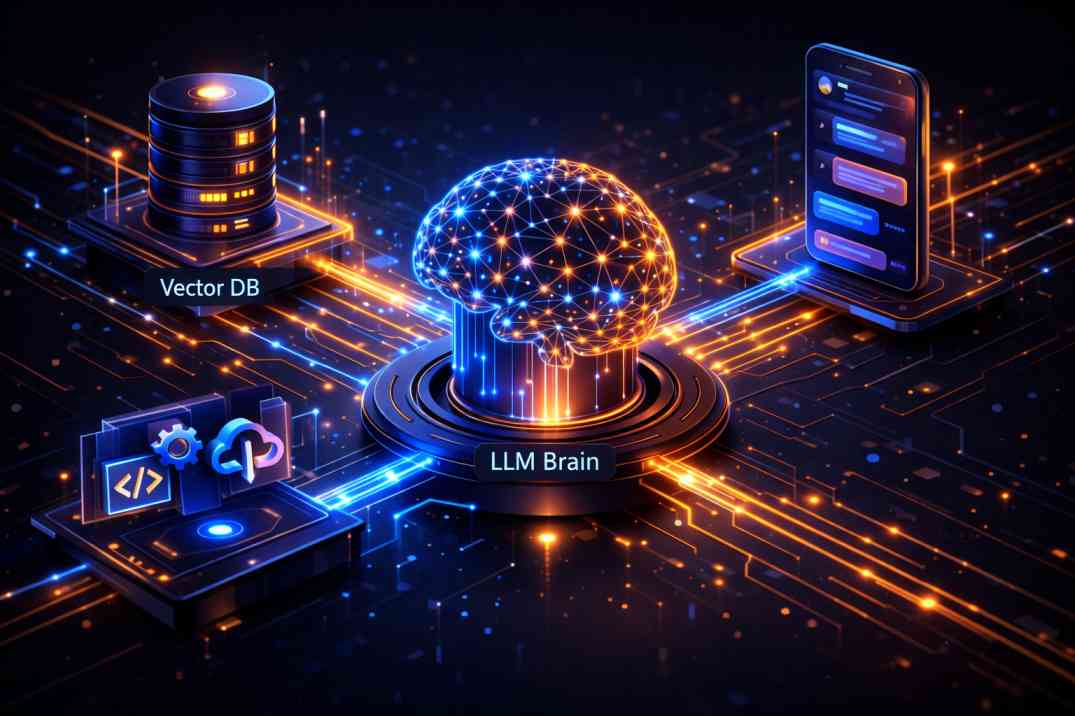
LLM orchestration is the architectural layer that sits between your user interface, your backend systems, and the LLM itself. If the LLM is the reasoning engine, the orchestration layer is the vehicle. It manages memory, connects to external data sources, decides when to use specific tools, and strings together multiple AI calls to complete complex workflows.
Without orchestration, an LLM is a brilliant philosopher locked in a room without internet access. With orchestration, it becomes a powerful digital worker.
Pillar 1: Retrieval-Augmented Generation (RAG)
The most common hurdle developers face is that LLMs don't know your private data. They don't know your company's internal documentation, your user's specific database records, or the news that broke an hour ago. Fine-tuning a model for knowledge retrieval is wildly expensive and quickly becomes outdated. The industry-standard solution is RAG.
Here is how a robust RAG pipeline is orchestrated:
- Document Ingestion & Chunking: You take your raw data (PDFs, database rows, website scrapes) and break it down into smaller, semantically meaningful chunks.
- Vector Embeddings: You pass these chunks through an embedding model (like OpenAI's
text-embedding-3-small). This translates the human text into mathematical arrays (vectors) that capture the underlying meaning of the content. - The Vector Database: These vectors are stored in a specialized Vector DB (such as Pinecone, Milvus, or a PostgreSQL database with the
pgvectorextension). - The Retrieval Phase: When a user asks a question, their query is also converted into a vector. The orchestration layer runs a mathematical similarity search in the Vector DB to find the chunks of your data that most closely match the user's question.
- The Generation Phase: Finally, the orchestration layer constructs a new prompt: "Answer the user's question strictly using the following context..." It injects the retrieved chunks into this prompt and sends it to the LLM.
The result? Factual, grounded answers based entirely on your proprietary data, with zero hallucinations.
Pillar 2: Function Calling and Tool Use
If RAG gives the LLM memory, Function Calling (or Tool Use) gives it hands. This is where applications transition from being informational to being operational.
Modern models are trained to recognize when they need external help to answer a prompt. As a developer, you provide the LLM with a JSON schema defining the tools available to it. For example, you might define a tool called check_inventory(product_id) or create_calendar_event(time, title).
When a user types, "Book a meeting with the sales team for tomorrow at 2 PM," the orchestration flow looks like this:
- The LLM receives the prompt and the list of available tools.
- Instead of generating a text response, the LLM outputs a structured JSON command indicating it wants to use the
create_calendar_eventtool, properly formatting the date and time arguments. - Your backend intercepts this response. The LLM does not execute the code. Your backend executes the actual API call to Google Calendar or Microsoft Graph.
- Your backend takes the success/failure response from the Calendar API and feeds it back to the LLM.
- The LLM formulates a final, human-readable response: "I've successfully booked your meeting for 2 PM tomorrow."
Architecting the Modern AI Stack
Building these sophisticated systems requires a solid architectural foundation. Let's look at a highly effective stack for building cross-platform smart applications:
- The Frontend (The Interface): A robust, cross-platform framework like Flutter is ideal here. It allows you to build rich, reactive UIs for iOS, Android, and Web simultaneously. Flutter handles the complex UI states required for streaming LLM responses and displaying interactive widgets generated by AI tool calls.
- The Backend (The Orchestrator): You should never embed LLM API keys directly in your frontend. A powerful backend framework like Laravel (PHP) serves as the perfect orchestration hub. Your Laravel application secures your API keys, manages user authentication, connects to your primary relational database, and handles the complex logic of chaining LLM calls and executing internal tools.
- The Infrastructure: Deploying this requires a reliable environment. Hosting your Laravel backend and databases on a capable VPS setup (like those provided by Hostinger or AWS) ensures you have the processing power to handle concurrent AI requests and vector searches without latency bottlenecks.
Conclusion
Building "Smart Tech" means moving beyond simple prompt engineering. By mastering frameworks like LangChain, integrating Vector Databases for RAG, and securely wiring up backend tools through your APIs, you can build applications that truly understand context and automate complex workflows. The tools are here; it's time to start building the future.