The Bottleneck of Synchronous Execution
As your B2B SaaS platform scales, the complexity of a single user action grows exponentially. Consider what happens when a new enterprise client signs up on Smart Tech Devs: you need to create their user record, provision a dedicated database schema, subscribe them to a billing plan via Stripe, send a welcome email sequence, and notify the sales team on Slack. If you place all this logic inside a single controller method or a synchronous service class, the user will be left staring at a loading spinner for ten seconds. Worse, if the Slack API fails, the entire transaction might roll back, breaking the core onboarding experience.
To build durable, scalable products, we must shift from synchronous, procedural code to an Event-Driven Architecture (EDA).
The Power of Decoupling with Events and Listeners
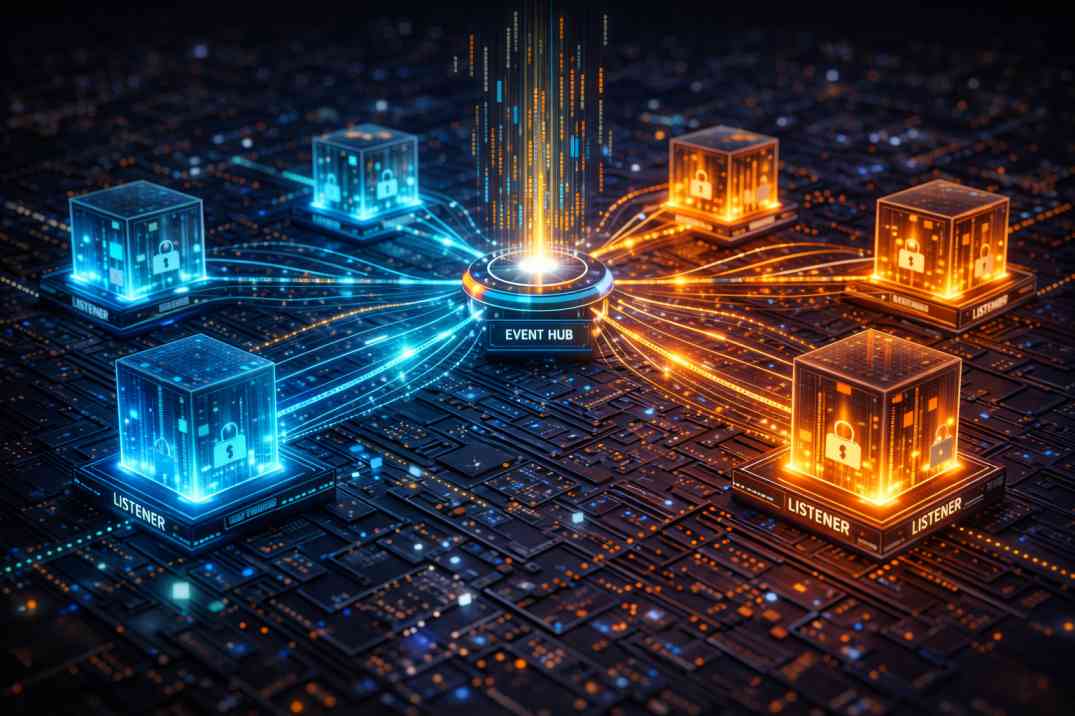
Event-Driven Architecture flips the script. Instead of a controller commanding other services to do their jobs, the controller simply announces that something happened (an Event). Independent, isolated classes (Listeners) hear that announcement and execute their specific tasks in the background.
In Laravel, this pattern is natively supported and elegantly implemented. It provides absolute separation of concerns. The authentication system doesn't need to know how the billing system works; it just needs to announce that a TenantRegistered event occurred.
Step 1: Defining the Event
An Event class in Laravel is a simple Data Transfer Object (DTO). It holds the information about what just happened.
namespace App\Events;

use App\Models\Tenant;
use Illuminate\Foundation\Events\Dispatchable;
use Illuminate\Queue\SerializesModels;

class TenantRegistered
{
    use Dispatchable, SerializesModels;

    public $tenant;

    /**
     * Create a new event instance.
     */
    public function __construct(Tenant $tenant)
    {
        $this->tenant = $tenant;
    }
}
Step 2: Creating Asynchronous Listeners
Next, we create dedicated Listeners. To ensure they don't block the main thread, we implement the ShouldQueue interface. This pushes the listener's logic onto a background queue (like Redis or Amazon SQS).
namespace App\Listeners;

use App\Events\TenantRegistered;
use Illuminate\Contracts\Queue\ShouldQueue;
use App\Services\InfrastructureService;

class ProvisionTenantSchema implements ShouldQueue
{
    protected $infrastructure;

    public function __construct(InfrastructureService $infrastructure)
    {
        $this->infrastructure = $infrastructure;
    }

    /**
     * Handle the event.
     */
    public function handle(TenantRegistered $event): void
    {
        // This runs in the background, safely away from the user's HTTP request
        $this->infrastructure->createDatabaseSchema($event->tenant);
    }
}
We can create multiple independent listeners for the exact same event: SubscribeTenantToStripe, SendWelcomeEmail, and NotifySalesTeam.
Real-World SaaS Application: Usage-Based Billing
One of the biggest trends in B2B SaaS for 2026 is the shift toward Usage-Based Pricing (UBP). EDA is the perfect infrastructure for this. If you charge per API call, you don't want to bloat your core application logic with billing meters.
Instead, simply dispatch an ApiRequestProcessed event at the end of your middleware. A dedicated MeterUsageListener will catch it in the background, aggregate the metrics, and update the billing provider asynchronously. Your core API remains blazing fast, while your revenue engine runs flawlessly in parallel.
Conclusion
Implementing an Event-Driven Architecture is a milestone in any platform's maturity. It transforms your monolithic spaghetti code into a highly organized, resilient system where failures in secondary systems (like a third-party email provider) no longer crash critical business workflows. Start decoupling your logic today to ensure your SaaS is ready to scale tomorrow.