The Nightmare of the 500 Server Error
As your B2B SaaS platform grows at Smart Tech Devs, you will inevitably start relying on Database Transactions to ensure data integrity. If a user pays an invoice, you need to update their wallet balance and mark the invoice as paid. If one fails, both must roll back. However, under high concurrency, you might suddenly start seeing a terrifying log entry: PDOException: SQLSTATE[40P01]: Deadlock detected.
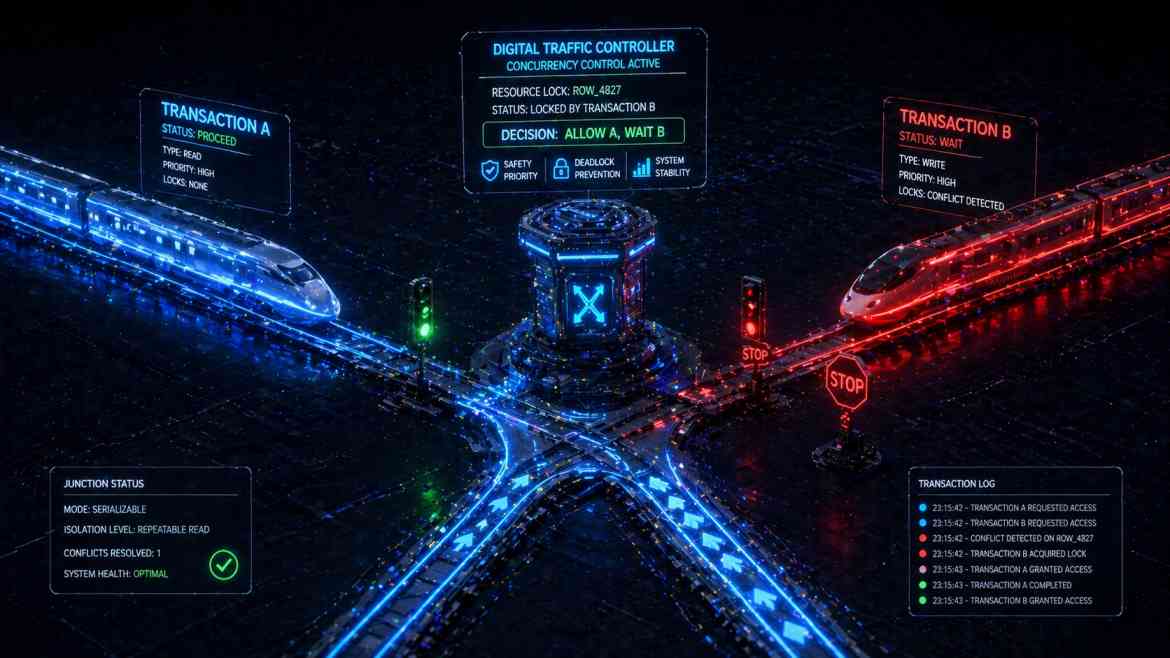
A deadlock occurs when two concurrent transactions are waiting for each other to release a database lock. Transaction A locks Row 1 and needs Row 2. Simultaneously, Transaction B locks Row 2 and needs Row 1. Neither can proceed. PostgreSQL detects this infinite standoff and aggressively kills one of the transactions, resulting in a failed API request and a frustrated user.
Strategy 1: Consistent Lock Ordering
The root cause of 99% of deadlocks is unpredictable lock ordering. If all transactions lock rows in the exact same order, a deadlock is mathematically impossible. One transaction will simply wait patiently behind the other.
Consider a scenario where users can transfer funds between wallets. If we aren't careful, concurrent transfers will crash.
// ❌ DANGEROUS PATTERN (Leads to Deadlocks)
public function transferFunds($fromWalletId, $toWalletId, $amount)
{
    DB::transaction(function () use ($fromWalletId, $toWalletId, $amount) {
        // Transaction A locks Wallet 1, Transaction B locks Wallet 2
        $from = Wallet::lockForUpdate()->find($fromWalletId);
        $to = Wallet::lockForUpdate()->find($toWalletId);

        $from->decrement('balance', $amount);
        $to->increment('balance', $amount);
    });
}
To fix this, we must enforce a strict, consistent order for locking rows—for instance, always locking the wallet with the lowest ID first.
// ✅ ENTERPRISE PATTERN (Consistent Ordering)
public function transferFundsSafely($fromWalletId, $toWalletId, $amount)
{
    // Determine strict order based on ID
    $firstId = min($fromWalletId, $toWalletId);
    $secondId = max($fromWalletId, $toWalletId);

    DB::transaction(function () use ($firstId, $secondId, $fromWalletId, $amount) {
        // Always lock in the exact same order
        $firstWallet = Wallet::lockForUpdate()->find($firstId);
        $secondWallet = Wallet::lockForUpdate()->find($secondId);

        // Re-assign references for business logic
        $from = ($firstWallet->id == $fromWalletId) ? $firstWallet : $secondWallet;
        $to = ($firstWallet->id == $fromWalletId) ? $secondWallet : $firstWallet;

        $from->balance -= $amount;
        $from->save();

        $to->balance += $amount;
        $to->save();
    });
}
Strategy 2: The Laravel Retry Helper
Even with perfect ordering, complex systems involving background jobs might still experience transient deadlocks due to index updates or complex cascades. For these scenarios, Laravel provides an incredibly elegant safety net: the transaction retry parameter.
By simply passing a second argument to DB::transaction, you instruct Laravel to automatically catch the deadlock exception and instantly retry the entire transaction up to a specified number of times.
public function processComplexInvoice(Invoice $invoice)
{
    // The '3' tells Laravel: If a deadlock occurs, try this entire block 3 times
    // before finally throwing the 500 error to the user.
    DB::transaction(function () use ($invoice) {

        $invoice->markAsPaid();
        $invoice->tenant->updateUsageMetrics();
        $invoice->affiliate->processCommission();

    }, 3);
}
Conclusion
Deadlocks are not a sign that PostgreSQL is failing; they are a sign that your platform is successfully handling massive scale. By understanding how to enforce consistent lock ordering and leveraging Laravel's built-in transaction retry mechanisms, you can transform a fragile, crash-prone backend into a highly resilient system that absorbs concurrent traffic flawlessly.