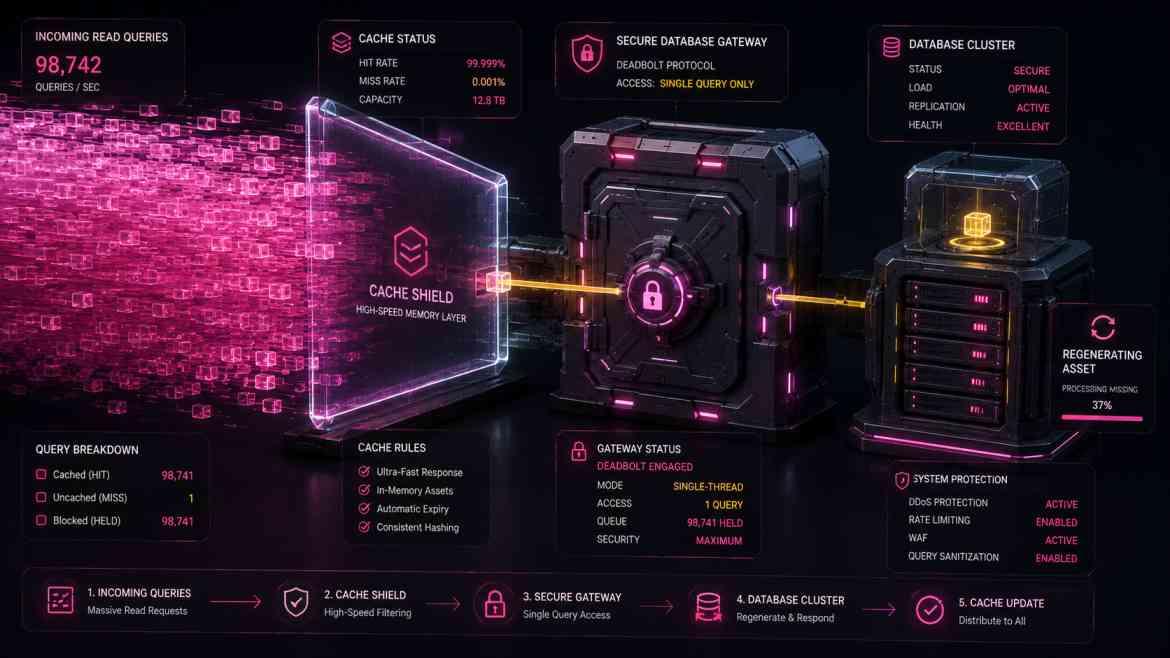
The Cache Stampede Avalanche
When engineering high-traffic applications at Smart Tech Devs, caching heavy database responses is your first line of defense. Suppose you have a massive enterprise analytics dashboard configuration that takes 4 seconds to compile from the database. You cache this payload data for 24 hours: Cache::remember('analytics_data', 86400, ...). This configuration handles traffic flawlessly—until the cache expires.
The exact millisecond that 24-hour window closes, the cache key becomes null. If 500 concurrent users hit that exact dashboard dashboard route at that exact instant, all 500 requests will discover a cache miss simultaneously. Because the cache is empty, all 500 requests will simultaneously execute the expensive 4-second database compilation query. Your database CPU spikes to 100%, connection pools exhaust, response times tank, and your application goes down. This failure is known as a **Cache Stampede** (or Thundering Herd problem). To survive high-traffic drops, you must enforce **Atomic Cache Locks**.
The Solution: Mutex-Gated Re-Generation
An atomic cache lock ensures that when a cache key expires, only *one single server process* is granted permission to talk to the database to rebuild the cache value. All other incoming requests are told to wait patiently or accept a slightly stale snapshot for a brief period, preventing the database from getting crushed.
Implementing Atomic Cache Locks in Laravel
Laravel provides an elegant execution wrapper using the Redis cache driver to handle distributed atomic locks natively across multi-server environments.
namespace App\Http\Controllers\Api;

use App\Http\Controllers\Controller;
use Illuminate\Support\Facades\Cache;
use Illuminate\Support\Facades\DB;

class DashboardMetricsController extends Controller
{
    public function getEnterpriseMetrics()
    {
        $cacheKey = 'enterprise_metrics_payload';
        $lockKey = 'metrics_regeneration_lock';

        // 1. Attempt to fetch data directly from the fast cache lane
        $data = Cache::get($cacheKey);

        if ($data) {
            return response()->json($data);
        }

        // 2. CACHE MISS: Secure an atomic lock using Redis before touching the DB
        // We acquire a lock for 10 seconds to allow the database calculation to complete
        $lock = Cache::lock($lockKey, 10);

        if ($lock->get()) {
            try {
                \Log::info("Lock secured. Regenerating metrics from core database tables.");

                // 3. Execute the heavy, intensive database aggregation query safely
                $data = DB::table('orders')
                    ->selectRaw('SUM(total) as revenue, COUNT(id) as volume, status')
                    ->groupBy('status')
                    ->get()
                    ->toArray();

                // 4. Populate the cache instantly for subsequent requests
                Cache::put($cacheKey, $data, now()->addDay());

                return response()->json($data);

            } finally {
                // Always release the atomic lock once processing concludes!
                $lock->release();
            }
        }

        // 5. FAIL-SAFE: If another worker process already locked the regeneration gate,
        // sleep briefly and retry fetching the newly cached data rather than crushing the DB.
        sleep(1);
        return response()->json(Cache::get($cacheKey) ?? ['status' => 'processing_retry']);
    }
}
The Engineering ROI
By implementing atomic cache gates on heavy analytical lookups, you build a highly predictable data tier. High-frequency expiration windows can no longer cause sudden cascading hardware failures. Your database handles a smooth, metered workload, while your distributed Redis nodes comfortably shoulder the concurrent traffic volume without breaking a sweat.