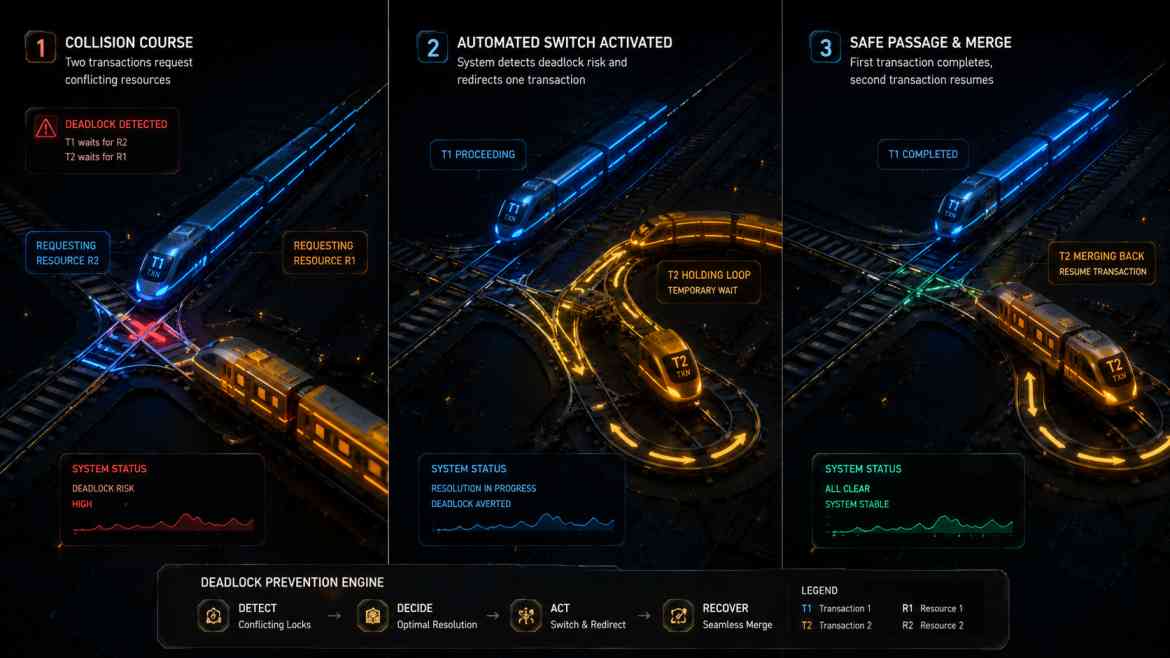
The Concurrency Collision
As your B2B SaaS platform at Smart Tech Devs scales to handle thousands of concurrent operations, you will inevitably encounter the most frustrating database error in backend engineering: the Deadlock (e.g., PostgreSQL 40P01: deadlock detected or MySQL 1213 Deadlock found when trying to get lock).
A deadlock occurs when two concurrent transactions are waiting for each other to release a row lock. For example, Worker A locks Row 1 and needs Row 2. At the exact same millisecond, Worker B locks Row 2 and needs Row 1. They are locked in an infinite Mexican standoff. The database engine's only solution is to violently terminate one of the transactions, throwing a fatal 500 error to the user or crashing the background queue job.
The Enterprise Solution: Automated Retries
You cannot entirely eliminate deadlocks in a highly concurrent, complex relational database. However, you can make them completely invisible to the end user. When a transaction is chosen as the "deadlock victim" and terminated, the operation is perfectly valid—it just collided with bad timing. If you simply wait a fraction of a second and try again, it will almost certainly succeed.
Architecting Resilient Transactions
Laravel provides an incredibly elegant, built-in mechanism to handle this. The DB::transaction() method accepts an optional second parameter: the retry count.
namespace App\Services;

use Illuminate\Support\Facades\DB;
use Illuminate\Database\QueryException;

class FinancialLedgerService
{
    public function transferFunds($fromAccountId, $toAccountId, $amount)
    {
        // ❌ THE ANTI-PATTERN: A deadlock here throws a fatal 500 error
        // DB::transaction(function () use (...) { ... });

        // ✅ THE ENTERPRISE PATTERN: The magic "5" parameter
        // If a deadlock occurs, Laravel catches the exception, sleeps briefly,
        // and safely re-attempts the entire closure up to 5 times.
        return DB::transaction(function () use ($fromAccountId, $toAccountId, $amount) {

            // 1. Deduct from source account
            $fromAccount = Account::where('id', $fromAccountId)->lockForUpdate()->first();
            $fromAccount->balance -= $amount;
            $fromAccount->save();

            // 2. Add to destination account
            $toAccount = Account::where('id', $toAccountId)->lockForUpdate()->first();
            $toAccount->balance += $amount;
            $toAccount->save();

            // 3. Record ledger entry
            Ledger::create([
                'from_id' => $fromAccountId,
                'to_id' => $toAccountId,
                'amount' => $amount
            ]);

            return true;

        }, 5); // Attempt this transaction a maximum of 5 times before officially failing
    }
}
The Engineering ROI
By appending a retry limit to your critical transactions, you build a self-healing data layer. When a deadlock occurs during a massive traffic spike, your application no longer throws fatal exceptions or drops user requests. The framework silently absorbs the collision, retries the operation, and resolves the request successfully, completely masking the database contention from your clients.