The Hardest Decision in B2B SaaS
When you build a B2C application, data is simple: every user has their own data. But when you build a B2B SaaS platform (like an inventory system for different companies), you enter the complex world of Multi-Tenancy.
You have Company A and Company B using the same application. The absolute worst-case scenario in SaaS is Company A accidentally seeing Company B's financial data. Preventing this data leakage is the most critical architectural decision you will make, and you have to choose between two fundamentally different database strategies.
Strategy 1: The Shared Database (Global Scopes)
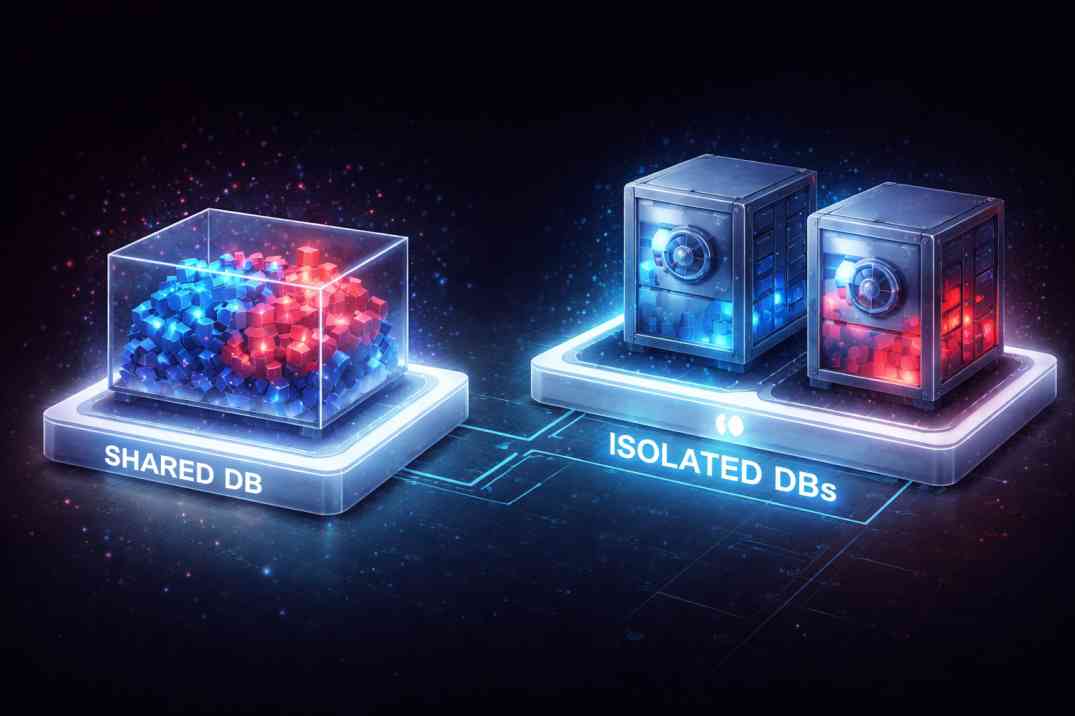
The most common approach is throwing everyone into the same database and adding a tenant_id column to every single table.
In Laravel, you enforce this using Global Scopes. Every time a developer queries the invoices table, Laravel automatically appends WHERE tenant_id = 1 behind the scenes.
// Inside an Eloquent Model
protected static function booted()
{
    static::addGlobalScope('tenant', function (Builder $builder) {
        $builder->where('tenant_id', session('current_tenant_id'));
    });
}
The Pros: It is incredibly cheap to host and very easy to run migrations. You only have one database to maintain.
The Cons: It is highly risky. If a developer accidentally writes a raw SQL query and forgets the tenant_id, or if a global scope drops during a complex background job, you instantly leak data across companies.
Strategy 2: Database Isolation (Separate DBs)
For enterprise B2B platforms, we prefer strict Database Isolation. Company A gets database_a, and Company B gets database_b.
Using packages like Tenancy for Laravel, the application dynamically swaps the database connection based on the user's login or the subdomain (e.g., companya.smarttechdevs.in).
The Pros: Total data security. It is mathematically impossible for Company A to query Company B's data because they are physically separated. It also makes backing up or deleting a single client's data incredibly easy.
The Cons: DevOps complexity. When you deploy a new feature, you aren't running php artisan migrate once. You have to loop through and run it 50 times for 50 different client databases.
The Verdict
If you are building a low-cost, high-volume SaaS, stick to the Shared Database with strict Global Scopes and heavy automated testing. But if you are building enterprise B2B software where data privacy is legally mandated, you must take the hit on DevOps complexity and architect strict Database Isolation.