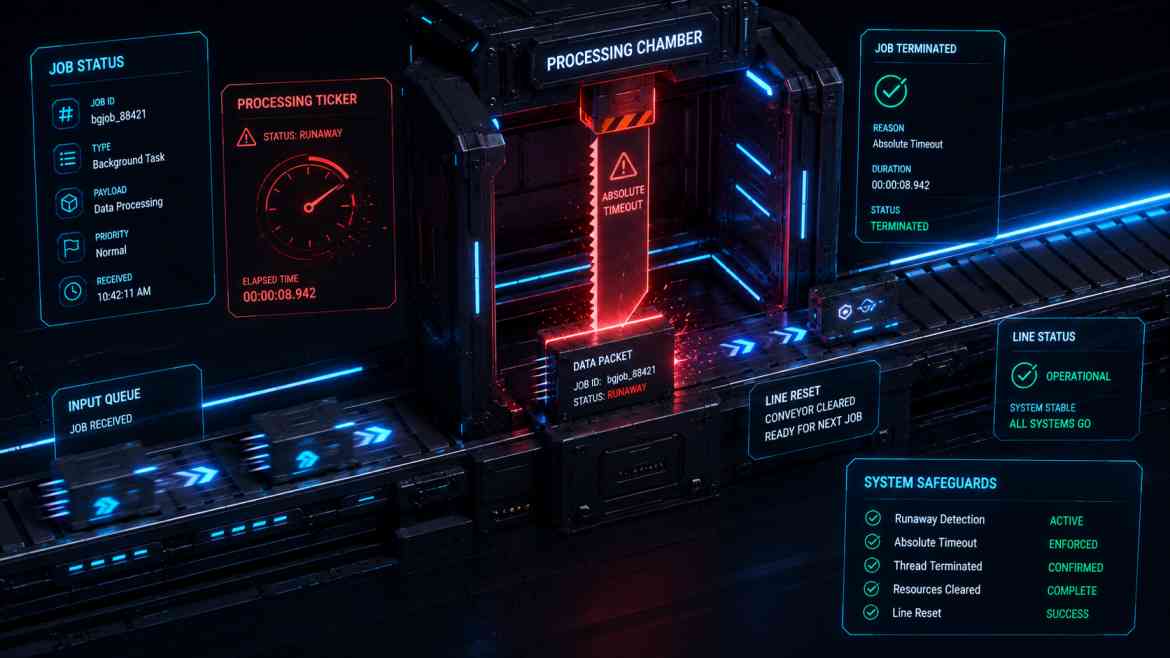
The Stuck Worker Nightmare
When engineering a scalable B2B SaaS background architecture at Smart Tech Devs, background queues are your primary defense against web response delays. However, moving tasks out of the HTTP lifecycle doesn't make them completely invulnerable. A dangerous operational trap occurs when an asynchronous background job locks up mid-execution, causing infinite hangups.
Imagine a job configured to connect to an external server via an FTP or cURL handshake. If the target server hangs without dropping the socket connection, and your code doesn't define an explicit connection timeout, the background process will stall indefinitely. That queue worker thread is now permanently frozen. As more identical jobs fire, your entire worker pool will lock up, paralyzing your SaaS backend processing pipelines. To secure your systems, you must configure absolute **Process Timeouts**.
The Double Safety Guardrail: Job vs. Worker Timeouts
To build a bulletproof background infrastructure, Laravel provides a two-tiered timeout guardrail system that utilizes the native PHP PCNTL extension to forcefully kill stuck worker loops before they exhaust your infrastructure capacity.
Step 1: Implementing Component-Level Job Timeouts
The first line of defense is defining a strict time limit directly within the specific Job class. If the job runs longer than this specified number of seconds, Laravel's worker loop will flag it as a failure and safely terminate the process thread.
namespace App\Jobs;

use Illuminate\Bus\Queueable;
use Illuminate\Contracts\Queue\ShouldQueue;
use Illuminate\Foundation\Bus\Dispatchable;
use Illuminate\Queue\InteractsWithQueue;
use Illuminate\Queue\SerializesModels;

class ProcessVendorSync implements ShouldQueue
{
    use Dispatchable, InteractsWithQueue, Queueable, SerializesModels;

    /**
     * 1. The number of seconds the job can run before timing out.
     * We cap this heavy integration job strictly at 2 minutes (120 seconds).
     */
    public int $timeout = 120;

    /**
     * 2. The number of times the job may be attempted before failing.
     */
    public int $tries = 3;

    public function handle(): void
    {
        // ❌ HAZARDOUS CODE: If this external stream blocks indefinitely,
        // Laravel's internal $timeout parameter will forcefully kill it after 120s.
        $data = file_get_contents('https://brittle-vendor-api.com/stream/dump');

        // Process data...
    }
}
Step 2: Enforcing Global Worker Lifespans via Supervisor
While assigning a $timeout property inside your classes is highly effective, it relies on developers remembering to write it every single time. To protect your server globally, you must configure a hard process lifespan directly inside your **Supervisor configuration file** as a global fail-safe fallback.
# /etc/supervisor/conf.d/laravel-worker.conf

[program:laravel-worker]
command=php /var/www/smarttechdevs.com/artisan queue:work --timeout=150
# CRITICAL RULE: stopwaitsecs must ALWAYS be longer than your worker --timeout value!
# This ensures Supervisor gives Laravel enough time to kill the stuck job safely
# and write the failure logs before Supervisor forcefully restarts the entire thread.
stopwaitsecs=160
autostart=true
autorestart=true
The Engineering ROI
By coordinating your explicit model class timeouts with your root system Supervisor configurations, your queue processing grid becomes self-healing. A stuck third-party integration loop or unhandled infinite loop can no longer take down your background queues. Stuck jobs are systematically cut, tracked in your failed jobs logging tables for developer review, and fresh workers take over immediately.