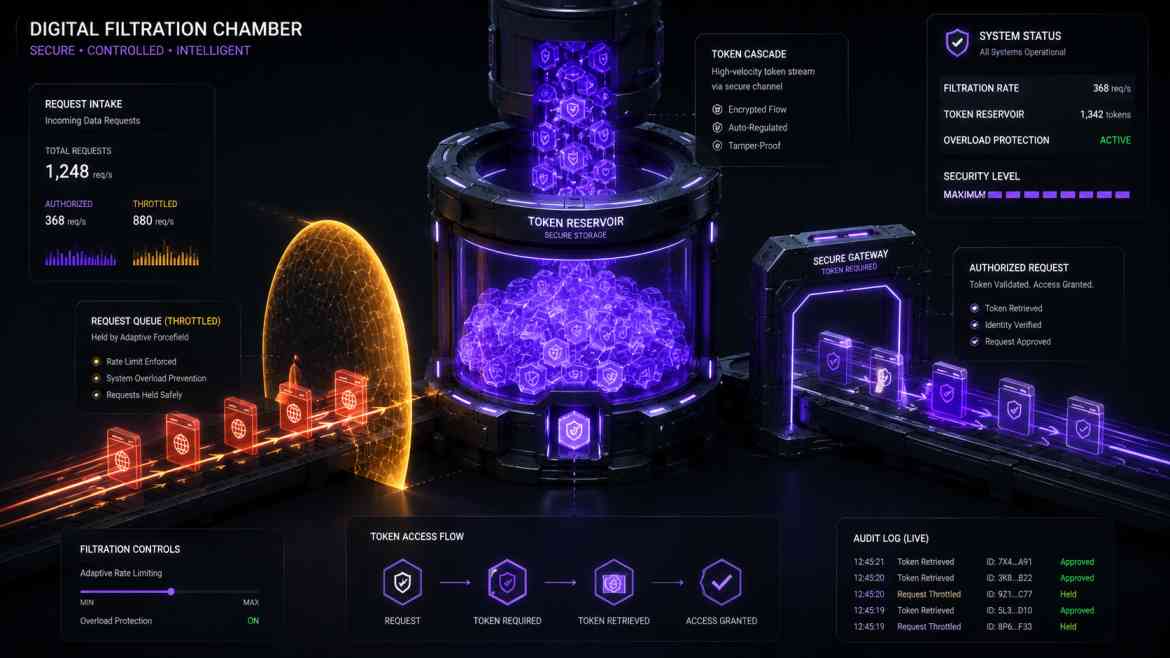
The Silent Vendor Ban Danger
When architecting a high-performance B2B SaaS platform at Smart Tech Devs, your system frequently depends on external third-party service endpoints. Whether you are validating corporate GST/VAT IDs, fetching real-time customs data, or pushing logs to enterprise CRM hubs, your background jobs handle these connections asynchronously via parallel queue worker pools.
The core structural danger occurs when a sudden surge of jobs executes concurrently across 20 distinct queue worker threads. If each worker starts blasting HTTP requests to a vendor API simultaneously, you will rapidly violate their strict API threshold rules. Instead of handling your data, the vendor's gateway flags your server IP, returns a 429 Too Many Requests code, and blocks your connections. Your queues stall, retries exhaust, and critical sync integrations break down completely. To defend your system from vendor blocks, you must implement a distributed **Token Bucket Rate Limiter**.
The Physics of the Token Bucket Algorithm
Unlike basic time-window throttlers (which completely lock access for an hour once a limit is hit), the Token Bucket algorithm provides a smooth, continuous flow control pipeline.
Imagine a bucket that holds a maximum number of virtual access tokens. A background ticker automatically drops fresh tokens into the bucket at a fixed, predictable rate (e.g., 5 tokens per second). When an application worker wants to execute an external API call, it must extract exactly one token from the bucket. If the bucket is empty, the worker must pause and wait. This algorithm elegantly accommodates sudden brief traffic bursts while guaranteeing that your long-term connection volume stays perfectly within vendor boundaries.
Step 1: Implementing a Distributed Token Bucket via Redis in Laravel
Because your Laravel application runs across multiple web servers or parallel worker nodes, you cannot track token counts in local PHP memory. We must leverage **Redis** to maintain an atomic, central token balance pool globally.
namespace App\Jobs;

use Illuminate\Bus\Queueable;
use Illuminate\Contracts\Queue\ShouldQueue;
use Illuminate\Foundation\Bus\Dispatchable;
use Illuminate\Queue\InteractsWithQueue;
use Illuminate\Queue\SerializesModels;
use Illuminate\Support\Facades\Http;
use Illuminate\Support\Facades\Redis;

class SyncVendorCrmRecord implements ShouldQueue
{
    use Dispatchable, InteractsWithQueue, Queueable, SerializesModels;

    public array $payload;

    public function __construct(array $payload)
    {
        $this->payload = $payload;
    }

    public function handle(): void
    {
        $limiterName = 'crm-api-token-bucket';

        // Enforce the Token Bucket rule atomically via Redis globally across all servers
        // Bucket Capacity: 30 tokens max. Refill Rate: 5 tokens per second.
        Redis::throttle($limiterName)
            ->allow(30)          // Maximum burst capacity of the bucket
            ->every(1)           // Time window in seconds
            ->releaseAfter(10)   // Delay time before releasing the job lock on failure
            ->block(5)           // If bucket is empty, block worker for up to 5s before giving up
            ->then(function () {

                // Token successfully acquired! Execute the external network mutation safely
                $response = Http::withToken(config('services.vendor.key'))
                    ->post('https://api.externalcrm.com/v2/records', $this->payload);

                if ($response->failed()) {
                    $this->release(now()->addMinutes(2)); // Back off gracefully on application errors
                }

            }, function () {
                // Could not acquire a token within 5 seconds.
                // Release the job back into the queue pool to be retried automatically later.
                return $this->release(now()->addSeconds(15));
            });
    }
}
The Engineering ROI
By shifting to a Redis-backed Token Bucket architecture for third-party integrations, you decouple your processing speed from vendor limitations. A massive internal queue backup will no longer trigger cascading 429 exceptions or IP bans. Your background workers smoothly pace their outgoing HTTP traffic loops automatically, preserving your external data pipelines and maintaining flawless business operations.