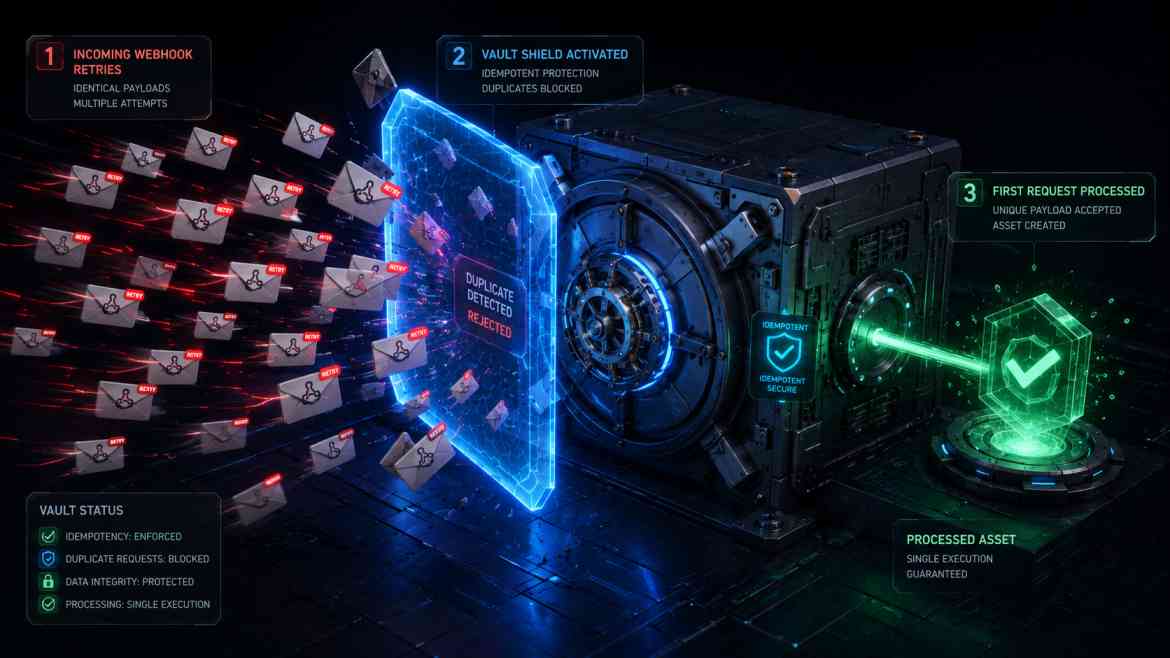
The Double-Billing Nightmare
When integrating with enterprise payment processors like Stripe or enterprise CRMs at Smart Tech Devs, relying on webhooks is mandatory. However, distributed systems are inherently chaotic. If Stripe sends your API a charge.succeeded webhook, it expects a 200 OK HTTP response within 3 seconds.
If your Laravel server takes 4 seconds to provision the user's workspace, Stripe assumes the delivery failed and fires a retry. Now your server is processing the exact same $5,000 enterprise charge a second time. Suddenly, you have provisioned two workspaces, dispatched two receipts, and corrupted your accounting ledger. To survive these inevitable retry storms, your webhook endpoints must be architected for Idempotency.
What is Idempotency?
In mathematics and computer science, an idempotent operation is one that produces the exact same result whether it is executed once or ten thousand times.
To achieve this in Laravel, we use the unique Event ID provided by the vendor (e.g., Stripe's evt_12345) as an Idempotency Key. When a webhook arrives, we instantly lock that Event ID in our database or Redis cache. If a retry arrives 2 seconds later while the first job is still processing, our system sees the lock, ignores the duplicate payload, and returns a graceful 200 OK to satisfy the vendor.
Step 1: Architecting the Idempotent Job
We offload the webhook processing to a background Queue Worker to ensure we reply to the vendor instantly, and we wrap the actual business logic inside a strict atomic Redis lock.
namespace App\Jobs;

use Illuminate\Bus\Queueable;
use Illuminate\Contracts\Queue\ShouldQueue;
use Illuminate\Foundation\Bus\Dispatchable;
use Illuminate\Support\Facades\Cache;

class ProcessStripePayment implements ShouldQueue
{
    use Dispatchable, Queueable;

    public array $webhookPayload;

    public function __construct(array $payload)
    {
        $this->webhookPayload = $payload;
    }

    public function handle(): void
    {
        // 1. Extract the globally unique Event ID from the vendor
        $eventId = $this->webhookPayload['id'];
        $lockKey = "webhook_processing_{$eventId}";

        // 2. ATOMIC LOCK: We attempt to acquire a lock for 10 minutes.
        // The get() method returns false immediately if another worker already holds this lock!
        $lock = Cache::lock($lockKey, 600);

        if (! $lock->get()) {
            // A retry storm is happening! Another thread is already handling this exact event.
            \Log::info("Idempotency Triggered: Silently dropping duplicate webhook {$eventId}.");
            return;
        }

        try {
            // 3. We hold the lock. Execute the critical business logic ONCE.
            \Log::info("Processing payment for Event {$eventId}...");

            // Provision workspace, send receipt, update ledger...

            // 4. Record permanent success so future identical webhooks (days later) are also ignored
            Cache::put("webhook_completed_{$eventId}", true, now()->addDays(30));

        } catch (\Exception $e) {
            // 5. If our logic FAILS, we release the lock so the next Stripe retry can safely attempt it again.
            $lock->release();
            throw $e;
        }
    }
}
Step 2: The Controller Hand-off
Your API controller is now purely a traffic cop. It verifies the signature, dispatches the job, and immediately hangs up the phone to prevent vendor timeouts.
public function handleWebhook(Request $request)
{
    // (Assuming HMAC signature validation middleware has already passed)

    // Check if we already permanently completed this event in the past
    $eventId = $request->input('id');
    if (Cache::has("webhook_completed_{$eventId}")) {
        return response()->json(['status' => 'already_processed']);
    }

    // Dispatch the idempotent job and reply in < 50ms
    ProcessStripePayment::dispatch($request->all());

    return response()->json(['status' => 'queued']);
}
The Engineering ROI
Idempotency is the ultimate safety net for distributed systems. By relying on atomic Redis locks and vendor-supplied Event IDs, you completely decouple your application's data integrity from the unpredictability of network latency. You eliminate the risk of double-billing, prevent database corruption, and build an API that gracefully absorbs massive retry storms without breaking a sweat.