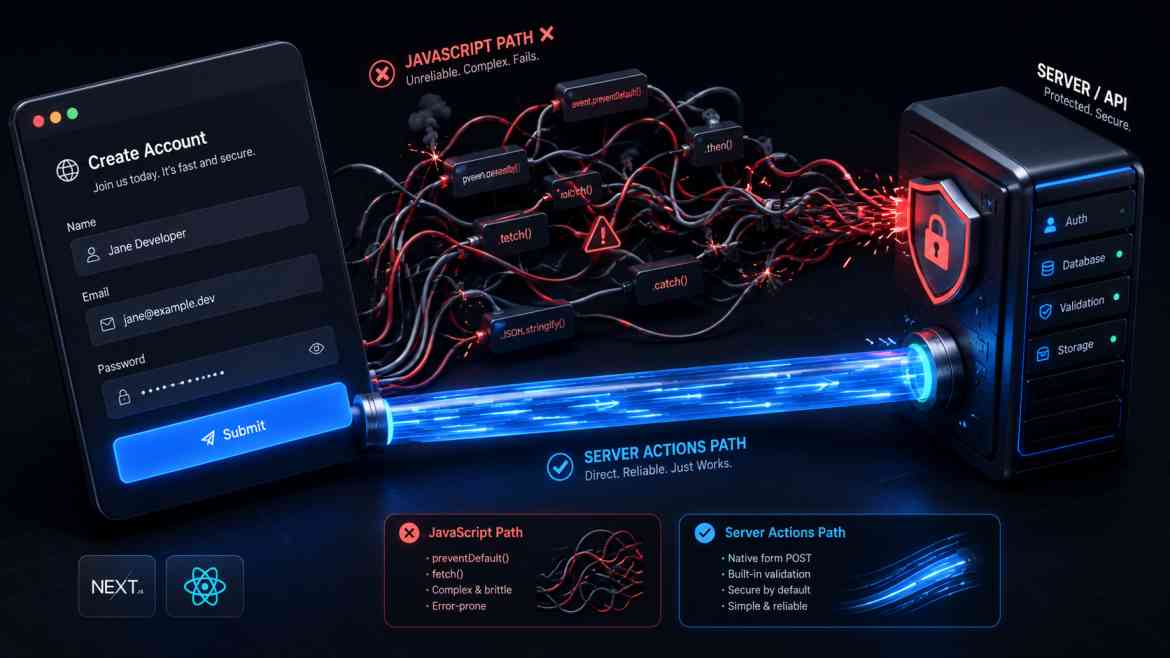
The Brittle Client-Side Fetch
For the last decade, building a form in React required a massive amount of boilerplate. You had to wire up onSubmit handlers, call e.preventDefault(), manage isLoading and isError states via useState, and manually construct fetch() calls to an external API endpoint.
This architecture at Smart Tech Devs created two major problems. First, it bloated the client bundle with API routing logic. Second, it was incredibly brittle. If a user was on a flaky train Wi-Fi connection and the JavaScript bundle failed to download, or if they clicked "Submit" before React had finished hydrating the page, the form was completely dead. The button would do nothing. To build enterprise-grade, resilient interfaces, we must return to the web's roots using Progressive Enhancement via Next.js Server Actions.
The Solution: Server Actions & useActionState
Next.js Server Actions allow you to define asynchronous server functions that can be called directly from your React components. When combined with the native HTML <form action={...}> attribute, the browser can submit the form natively without requiring a single byte of client-side JavaScript to be loaded.
Step 1: Architecting the Server Action
We define our mutation logic in an isolated file, marked with the "use server" directive. This code runs exclusively on your backend, meaning you can talk to your database directly.
// app/actions/updateProfile.ts
"use server";

import prisma from '@/lib/prisma';
import { revalidatePath } from 'next/cache';

// Action state signature required by the new useActionState hook
export async function updateProfile(prevState: any, formData: FormData) {
    const name = formData.get('name') as string;

    if (!name || name.length < 3) {
        return { success: false, message: "Name must be at least 3 characters." };
    }

    try {
        await prisma.user.update({
            where: { id: 'usr_123' },
            data: { name }
        });

        // Instantly purge the Next.js router cache to show the fresh data
        revalidatePath('/dashboard');
        return { success: true, message: "Profile updated securely." };

    } catch (error) {
        return { success: false, message: "A database error occurred." };
    }
}
Step 2: Wiring the Progressively Enhanced Client Component
We bind this Server Action to our form using the modern useActionState hook (formerly useFormState). This completely eliminates manual loading states and fetch logic.
// app/dashboard/ProfileForm.tsx
"use client";

import { useActionState } from 'react';
import { updateProfile } from '@/app/actions/updateProfile';
import { useFormStatus } from 'react-dom';

// Isolated submit button to automatically track the pending state of the parent form
function SubmitButton() {
    const { pending } = useFormStatus();
    return (
        <button
            type="submit"
            disabled={pending}
            className="px-4 py-2 bg-purple-600 text-white rounded disabled:opacity-50"
        >
            {pending ? 'Saving to Database...' : 'Update Profile'}
        </button>
    );
}

export default function ProfileForm() {
    // 1. Bind the Server Action to the local React state loop
    const [state, formAction] = useActionState(updateProfile, { success: false, message: '' });

    return (
        <div className="p-6 bg-white rounded-xl shadow border max-w-md">
            <h3 className="font-bold text-gray-800 mb-4">User Settings</h3>

            {/* 2. NATIVE FORM ACTION: This works even if JavaScript is disabled! */}
            <form action={formAction} className="flex flex-col space-y-4">

                <input
                    type="text"
                    name="name"
                    placeholder="Enter your full name"
                    className="p-2 border rounded focus:ring-2 ring-purple-500"
                    required
                />

                <SubmitButton />

                {/* 3. Render the server's response message natively */}
                {state?.message && (
                    <p className={`text-sm ${state.success ? 'text-green-600' : 'text-red-500'}`}>
                        {state.message}
                    </p>
                )}
            </form>
        </div>
    );
}
The Engineering ROI
By migrating to Server Actions, you strip thousands of lines of boilerplate fetching logic from your client bundles. More importantly, you build zero-JS progressive enhancement natively into your SaaS. If a user hits "Submit" before your JavaScript bundle finishes hydrating on a slow 3G network, the browser handles the POST request perfectly, ensuring your platform never drops an interaction.