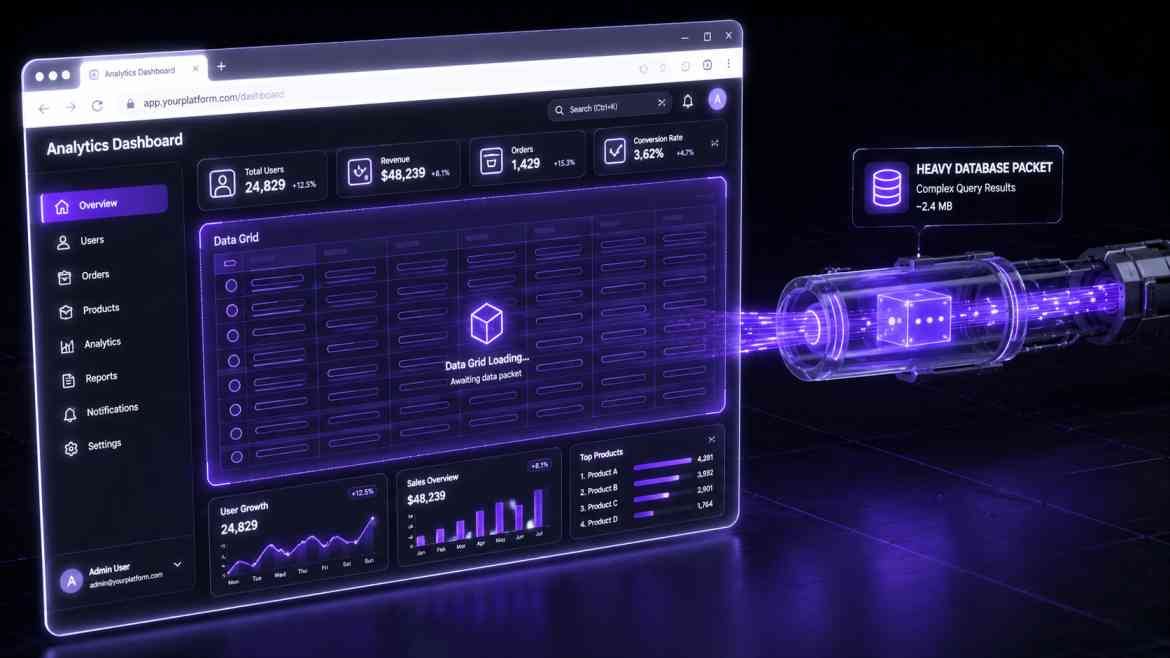
The Server-Side Rendering (SSR) Bottleneck
Server-Side Rendering is incredible for SEO and security. However, in older frameworks (like Next.js Pages Router using getServerSideProps), SSR had a massive architectural flaw: it was all-or-nothing. If a user requested a dashboard, the server had to fetch the user profile (10ms), the navigation data (20ms), and a massive historical analytics chart (1,500ms).
Because the server had to wait for the slowest query to finish before sending the HTML to the browser, the user stared at a completely blank white screen for 1.5 seconds. In B2B SaaS, a 1.5-second blank screen feels like the application has crashed. At Smart Tech Devs, we eliminate this bottleneck entirely using Streaming UI.
The Paradigm Shift: Streaming with Suspense
In the Next.js App Router, rendering is no longer blocked by slow data. We can stream the HTML in chunks. We send the fast, static parts of the page (like the Sidebar and Header) to the browser instantly. For the slow, heavy data, we leave a "placeholder" (a React Suspense boundary). The browser renders the layout immediately, shows a skeleton loader where the chart belongs, and then seamlessly swaps in the chart once the database finishes processing.
Architecting Granular Suspense Boundaries
To achieve this, we must isolate our data fetching into specific Server Components, rather than fetching everything at the top-level page.
// app/dashboard/page.tsx
import { Suspense } from 'react';
import { fetchUserProfile } from '@/lib/api';
import Sidebar from '@/components/Sidebar';
import Header from '@/components/Header';
import HeavyAnalyticsChart from '@/components/HeavyAnalyticsChart';
import ChartSkeleton from '@/components/ChartSkeleton';

export default async function DashboardPage() {
    // 1. Fetch the fast data. The page will NOT wait for the heavy chart data.
    const user = await fetchUserProfile();

    return (
        <div className="layout-grid">
            {/* 2. These components are streamed to the browser instantly */}
            <Sidebar />
            <main>
                <Header user={user} />

                {/* 3. The Suspense Boundary */}
                {/* Next.js instantly sends the ChartSkeleton to the browser.
                    Meanwhile, HeavyAnalyticsChart fetches its own data on the server.
                    When finished, Next.js streams the final HTML and replaces the skeleton. */}
                <Suspense fallback={<ChartSkeleton />}>
                    <HeavyAnalyticsChart tenantId={user.tenantId} />
                </Suspense>
            </main>
        </div>
    );
}
The Isolated Data Component
The heavy component is now responsible for its own asynchronous fetching. It acts as an isolated server node.
// components/HeavyAnalyticsChart.tsx
import { fetchComplexAnalytics } from '@/lib/db';
import { BarChart } from './ui/BarChart';

export default async function HeavyAnalyticsChart({ tenantId }: { tenantId: string }) {
    // This query takes 1.5 seconds.
    // Thanks to Suspense, it no longer blocks the rest of the page from loading!
    const data = await fetchComplexAnalytics(tenantId);

    return (
        <div className="p-6 bg-white rounded-lg shadow">
            <h2>Annual Revenue Trends</h2>
            <BarChart data={data} />
        </div>
    );
}
The Engineering ROI
By architecting your views with React Suspense and Streaming, you drastically improve your Time to First Byte (TTFB) and First Contentful Paint (FCP). The user perceives the application as lightning-fast because the interface reacts instantly to their click, keeping them engaged while the heavy backend processing finishes in the background.