The Hidden Cost of Styled-Components
Over the last few years, CSS-in-JS libraries like styled-components and emotion dominated the React ecosystem. They provided an incredible developer experience at Smart Tech Devs, allowing us to write CSS directly inside our JavaScript files and pass dynamic props effortlessly.
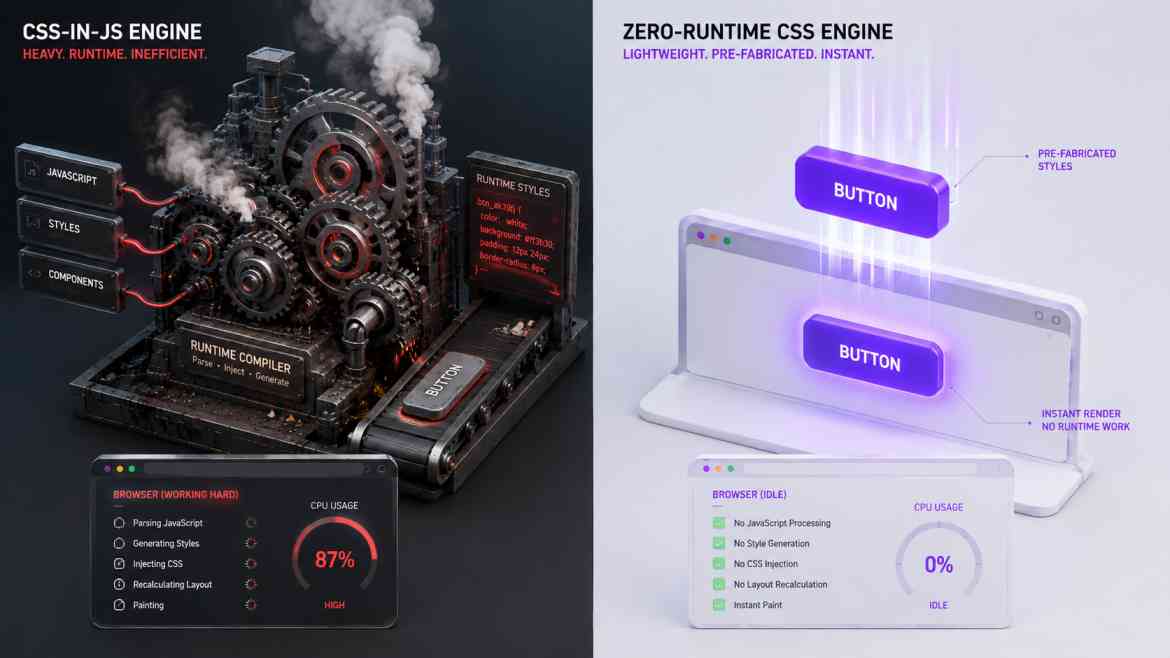
However, as we optimized our B2B dashboards for Next.js 14+ and strict Core Web Vitals, we hit a hard truth: Runtime CSS-in-JS is a massive performance bottleneck. When a user loads a page built with styled-components, the browser must first download the massive JavaScript bundle, execute the React component, parse the tagged template literals, dynamically generate hashed CSS class names, and finally inject a <style> tag into the DOM. This JavaScript execution blocks the Main Thread, severely degrading your Time to Interactive (TTI) and First Contentful Paint (FCP).
The Solution: Zero-Runtime CSS Architecture
To achieve 100/100 Lighthouse performance scores, your styling must be extracted to static .css files during the build step, completely bypassing the browser's JavaScript engine.
Modern architectures achieve this using Zero-Runtime tools like Tailwind CSS, standard CSS Modules, or build-time libraries like Vanilla Extract.
The Anti-Pattern: Runtime Execution
This standard styled-components approach forces the client's browser CPU to compile CSS on the fly. In Server-Side Rendering (SSR) environments like React Server Components, this pattern is often entirely unsupported because it requires access to the client-side DOM.
// ❌ THE ANTI-PATTERN: Heavy JS Runtime, incompatible with Next.js Server Components
import styled from 'styled-components';

const DashboardCard = styled.div`
  background-color: ${props => props.isDark ? '#1f2937' : '#ffffff'};
  padding: 24px;
  border-radius: 8px;
  box-shadow: 0 4px 6px -1px rgb(0 0 0 / 0.1);
`;

export default function Card({ isDark, children }) {
    return <DashboardCard isDark={isDark}>{children}</DashboardCard>;
}
The Enterprise Pattern: Build-Time Compilation
By shifting to utility classes (Tailwind) or CSS Modules, the styling is parsed by Webpack/Turbopack on your CI/CD server, not on the user's iPhone. The browser receives pure, static CSS that its native rendering engine can paint instantly without running a single line of JavaScript.
// ✅ THE ENTERPRISE PATTERN (Tailwind): Zero Runtime, 100% Server Component Compatible
export default function DashboardCard({ isDark, children }) {
    // We construct standard strings. The CSS already exists statically in the stylesheet!
    const themeClasses = isDark ? 'bg-gray-800 text-white' : 'bg-white text-gray-900';

    return (
        <div className={`p-6 rounded-lg shadow-md ${themeClasses}`}>
            {children}
        </div>
    );
}
The Engineering ROI
Migrating away from runtime CSS-in-JS results in dramatic performance gains. Your JavaScript bundle size shrinks significantly (as you no longer ship the styling compiler to the client), your hydration times plummet, and your Next.js application becomes fully compatible with high-performance React Server Components. By serving raw CSS directly to the browser, you let the browser do what it was originally designed to do: paint pixels instantly.