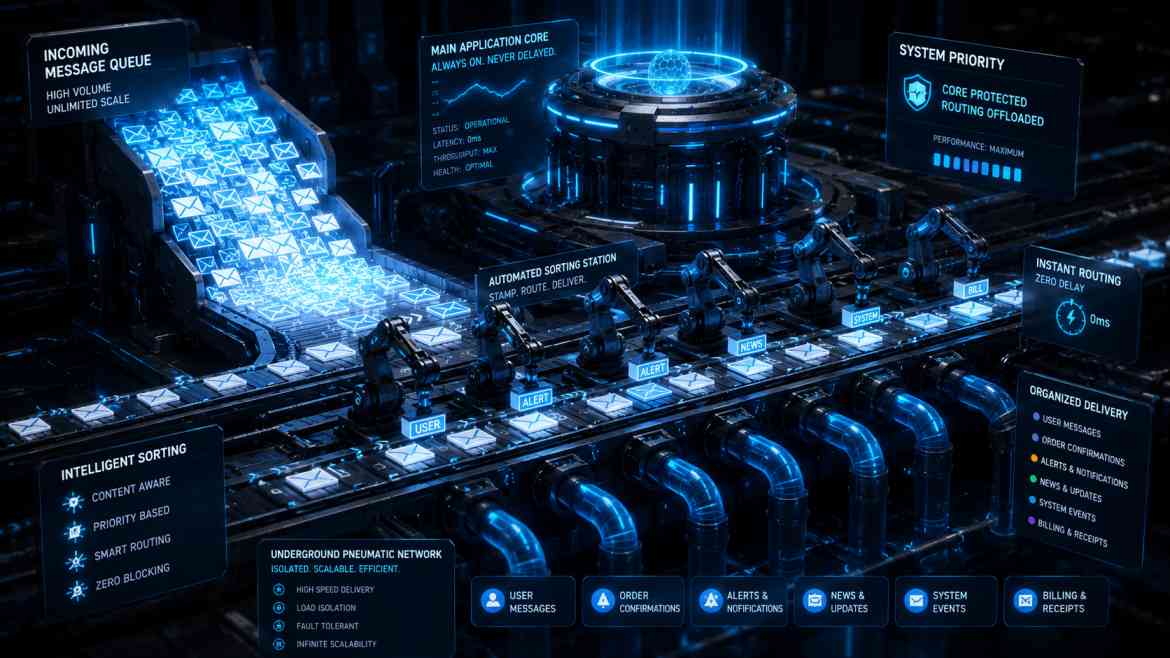
The Synchronous Mail Bottleneck
When building an enterprise B2B SaaS at Smart Tech Devs, sending transactional emails is inevitable—whether it is a welcome email, a password reset, or a monthly billing invoice. The baseline Laravel documentation makes sending mail look incredibly simple: Mail::to($user)->send(new InvoicePaid($invoice));.
For a local development environment, this works flawlessly. But in production, this is a severe architectural vulnerability. When your code invokes the send() method synchronously, the current HTTP request thread freezes. Your server opens a network socket, communicates with an external SMTP server (like Resend, Postmark, or Mailgun), waits for a TLS handshake, transfers the data, and waits for a success response. This network hop can easily take 2 to 3 seconds. For a user clicking a "Pay Invoice" button, a 3-second delay feels like a system freeze, and it drastically drops API throughput.
The Enterprise Solution: InteractsWithQueue & ShouldQueue
To build a high-performance backend, the HTTP response loop must never depend on external third-party network requests. We must handle mail asynchronously.
By shifting our mail delivery from the immediate synchronous runtime to an isolated background queue, the user request takes only a few milliseconds to save the database record and return a success UI, while a dedicated queue worker handles the network overhead in the background.
Architecting a Asynchronous Mailable
Laravel makes this architectural shift incredibly elegant. You simply implement the ShouldQueue contract on your Mailable class.
namespace App\Mail;

use App\Models\Invoice;
use Illuminate\Bus\Queueable;
use Illuminate\Contracts\Queue\ShouldQueue;
use Illuminate\Mail\Mailable;
use Illuminate\Mail\Mailables\Content;
use Illuminate\Mail\Mailables\Envelope;
use Illuminate\Queue\SerializesModels;

// Implementing ShouldQueue tells Laravel to automatically push this to the queue
class InvoicePaid extends Mailable implements ShouldQueue
{
    use Queueable, SerializesModels;

    public $invoice;

    public function __construct(Invoice $invoice)
    {
        // SerializesModels ensures only the ID is saved to the queue database/Redis,
        // preventing massive memory consumption in your queue.
        $this->invoice = $invoice;
    }

    public function envelope(): Envelope
    {
        return new Envelope(
            subject: 'Your Smart Tech Devs Invoice is Paid',
        );
    }

    public function content(): Content
    {
        return new Content(
            markdown: 'emails.invoices.paid',
        );
    }
}
Optimizing the Queue Connection
Once your mail class implements ShouldQueue, calling Mail::to($user)->send(new InvoicePaid($invoice)); will no longer halt your controller. Instead, Laravel serializes the model information and immediately stores it in your fast memory layer (like Redis) inside a fraction of a millisecond.
To keep your user interactions pristine, you should isolate your mail delivery to a dedicated background queue channel, ensuring heavy email blasts never block high-priority background jobs like financial ledger calculations.
// Inside your controller or action
Mail::to($request->user())
    ->onQueue('emails') // Route to a dedicated, lower-priority queue line
    ->send(new InvoicePaid($invoice));
The Engineering ROI
Asynchronous mail processing slashes your API response times down to the single-digit milliseconds. By separating your presentation layer from external SMTP infrastructure, you protect your application from cascading timeouts when third-party email APIs experience downtime. Your platform stays perfectly responsive, and your background queue scales seamlessly to process millions of transactions.